
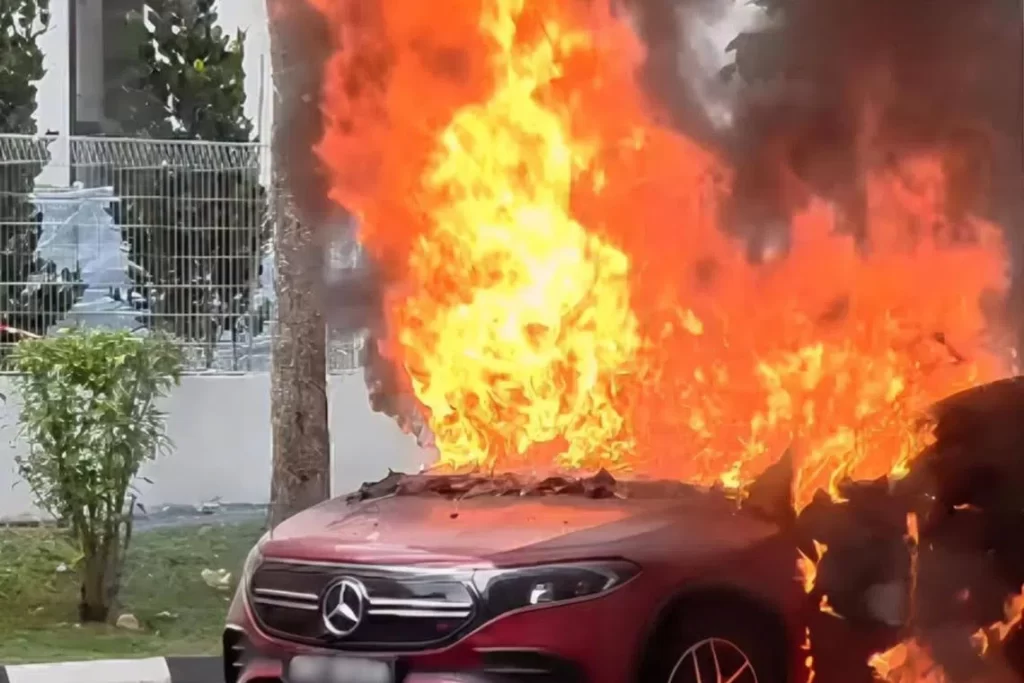
Photo Source: SCREENGRAB FROM SINGAPURA CHANNEL/FACEBOOK
SINGAPORE has built a substantial EV charging network and established national safety requirements for electric vehicles and charging installations. However, the Woodlands incident highlights an important distinction: charging readiness is not the same as being fully prepared to manage a fire involving an EV’s high-voltage battery.
An electric vehicle caught fire near the entrance of a multi-storey Housing & Development Board (HDB) carpark at Block 548 Woodlands Drive 44 on July 21, 2026.
The Singapore Civil Defence Force (SCDF) was alerted at around 10.10am. SCDF said the fire involved the vehicle’s interior and was extinguished using one water jet. No injuries were reported, and the cause of the fire remains under investigation.
The incident has renewed discussion about electric vehicle fire safety, the limitations of portable fire extinguishers and whether Singapore’s indoor and multi-storey carparks are sufficiently prepared as EV adoption grows.
The responsible conclusion is not that Singapore is unprepared. The country already has regulated charging installations, national EV charging standards, carpark fire-safety provisions and a growing public charging network.
The more important question is whether existing measures should be complemented by additional site-level protection and response planning in carparks with increasing numbers of electric vehicles.
What happened during the Woodlands Mercs EV Fire?
According to the driver’s account given to Shin Min Daily News and subsequently reported by The Straits Times, she noticed a burning smell while driving out of the carpark.
After pulling over, she realised that smoke was coming from the vehicle. She said the fire appeared to have started in the space between the driver’s and front passenger’s seats, beneath which she believed the vehicle’s battery was located.
The Woodlands Mercs EV Fire drew attention after nearby security personnel attempted to control the fire using portable fire extinguishers but were unsuccessful. As the fire continued to spread, those at the scene moved away and contacted SCDF.
A photograph taken after the incident showed extensive damage to the passenger compartment, including a heavily deformed dashboard and exposed seat-supporting structures.
Was the Woodlands fire caused by the EV battery?
It has not been confirmed that the vehicle’s high-voltage battery caused or was involved in the fire.
SCDF has stated that the cause remains under investigation. The driver’s account describes where she first observed the fire, but it is not a technical determination of the fire’s point of origin.
It would therefore be premature to describe the incident conclusively as a lithium-ion battery fire or a thermal-runaway event.
For now, it should be described as a fire involving an electric vehicle.
This distinction is important because not every fire involving an EV necessarily begins within its propulsion battery. The failure of a portable extinguisher also does not, by itself, prove that the high-voltage battery was burning.
Why are lithium-ion EV battery fires different?
When an EV’s high-voltage lithium-ion battery becomes involved, the incident can present hazards that differ from those associated with a conventional vehicle fire.
One of the main concerns is thermal runaway.
The United States National Transportation Safety Board describes thermal runaway as an uncontrolled increase in temperature and pressure within damaged battery cells. This can result in battery fire or reignition, while residual electrical energy may continue to create fire and electric-shock risks after the visible flames have been controlled.
Singapore’s Land Transport Authority (LTA) and SCDF similarly state that EV fires may involve thermal runaway within a high-voltage battery. Such fires may burn more intensely and can be more difficult to extinguish.
SCDF identifies possible warning signs of an EV battery fire as:
- Audible popping or hissing from the battery compartment
- Visible sparks
- A sudden large volume of greyish or whitish smoke
- Jet-like directional flames
These signs do not confirm the origin of every EV fire, but they may indicate possible battery involvement and the need to evacuate immediately.
Why might a fire extinguisher be insufficient?
Portable extinguishers may be useful for a small vehicle fire when it remains safe to approach.
However, the LTA and SCDF state that dry-powder extinguishers are less effective against fires involving EV batteries.
Attempting to fight a suspected battery fire without the correct equipment and training can expose members of the public to high voltage, intense heat, smoke and rapid fire development. The official advice is to move at least 15 metres away and call 995.
The unsuccessful extinguisher attempts during the Woodlands incident do not confirm that the vehicle’s battery was involved. They do, however, reinforce the importance of recognising when a fire is no longer safely manageable using first-aid firefighting equipment.
Can an EV fire spread to adjacent cars or damage a carpark structure?
Yes, a developing vehicle fire can spread to nearby vehicles and expose the surrounding structure to sustained heat. This risk is not unique to electric vehicles.
Vehicle-to-vehicle fire spread can occur in both electric and internal-combustion-engine vehicle fires. The risk is influenced by factors such as the fire’s size and duration, the distance between vehicles, combustible vehicle materials, ventilation and whether effective water-based suppression is available.
UK Government guidance for EVs in covered carparks states that water-based suppression can reduce the rate of fire spread to adjacent vehicles and buildings. It also notes that increased separation between parked cars can reduce radiant heat exposure and the likelihood of fire spreading from one vehicle to another.
The same guidance identifies structural fire resistance as an important consideration in covered carparks. Where a fire is prolonged or spreads to multiple vehicles, sustained heat can damage concrete, steel and other structural elements. The guidance notes that some major carpark fires have resulted in localised structural failure or severe damage requiring demolition and rebuilding.
Where an EV battery enters thermal runaway, the need for prolonged cooling and the possibility of reignition may further complicate control of the incident. This does not mean that every EV fire will spread or cause structural damage. It means that preventing escalation is particularly important in enclosed and densely parked environments.
Are electric vehicles more likely to catch fire?
Available Singapore data indicates that EVs currently have a lower reported fire incidence rate than internal-combustion-engine vehicles.
In 2025, EVs accounted for approximately 1.8% of vehicle fires despite representing around 6% of Singapore’s vehicle population.
According to the LTA and SCDF, this was equivalent to approximately:
- Seven fires per 100,000 EVs
- Twenty-two fires per 100,000 internal-combustion-engine vehicles
The available figures therefore do not support the claim that EVs catch fire more frequently than petrol or diesel vehicles.
The key issue is not necessarily how often EV fires occur. It is that a fire involving the high-voltage battery may require a different emergency response because of thermal runaway, high voltage, sustained cooling requirements and possible reignition.
Is Singapore ready for wider EV adoption?
Singapore is well advanced in charging deployment and regulation, but EV fire readiness must continue developing alongside the charging network.
The Ministry of Transport has set a target of 60,000 EV charging points by 2030, comprising 40,000 in public carparks and 20,000 on private premises.
As of March 2026, approximately 30,500 charging points had been deployed nationwide. The Government also plans to have at least one fast-charging hub in every HDB town by the end of 2027.
By December 2025, all HDB towns were described as EV-ready, with more than 90% of HDB carparks equipped with charging points.
In this context, EV-ready primarily refers to convenient access to charging infrastructure. It should not automatically be interpreted as meaning that every carpark has dedicated EV battery fire-suppression or vehicle-containment equipment.
What EV safety measures does Singapore already have?
Singapore has established regulations covering EVs, charging equipment and carpark fire safety.
All EVs approved for use in Singapore must comply with recognised international safety standards, including United Nations Regulation No. 100. EVs are also equipped with battery-management systems that monitor and regulate battery performance.
The Ministry of Transport states that Singapore Standard 722 became the national EV charging standard on April 1, 2026, replacing Technical Reference 25.
Under the Electric Vehicles Charging Act:
- Chargers must meet the LTA’s safety requirements and be certified and registered.
- Operators providing EV charging services must be licensed.
- New buildings and buildings undergoing significant works must provide a minimum level of charging infrastructure and sufficient supporting electrical capacity.
According to a joint response from the LTA, Building and Construction Authority and SCDF, carpark fire-safety measures include:
- Fire-rated walls and doors intended to limit fire spread
- Natural or mechanical ventilation to disperse smoke, heat and gases
- Sprinkler protection in enclosed basement carparks
- An emergency isolation switch within 15 metres of an EV charging station
The isolation switch cuts the electricity supply to the charging station and the vehicle being charged during an emergency.
A multi-agency EV Safety Taskforce co-chaired by the LTA and SCDF was also established in 2023 to review EV-related safety matters.
These measures provide a strong baseline. The remaining question is whether individual developments require additional measures based on their layout, occupancy, EV concentration and operating risks.
Charging readiness is not the same as fire readiness
Installing compliant chargers is an important part of the transition to electric mobility, but it is not the final step in EV fire preparedness.
Indoor and underground carparks can present additional operational challenges because smoke and heat may accumulate, access routes may be constrained and vehicles are commonly parked close to one another.
A prolonged vehicle fire may therefore affect more than the original vehicle. It can expose adjacent cars to radiant heat, interfere with evacuation and firefighting access, and potentially damage parts of the surrounding structure.
This does not mean that EVs should not be parked or charged indoors. It means that charging infrastructure should be considered alongside the building’s fire-protection systems, emergency procedures and site-specific risk profile.
A layered approach to EV car fire safety
King Fire’s EVProtect five-layer framework is a site-level approach for considering EV fire safety in indoor and underground carparks.
The five layers cover:
- EV battery-source fire suppression
- The building’s sprinkler system
- Mechanical ventilation and smoke management
- Water-barricade cooling containment
- A vehicle fire blanket
The EVProtect framework is not an SCDF or LTA regulatory requirement and does not replace the Singapore Fire Code. It is intended as a way for owners, managing agents and facility teams to consider how existing building systems may be complemented by EV-specific measures.
Learn more about the EVProtect five-layer framework here: https://www.kingfiresg.com/ev-car-fire-safety-indoor-underground-car-parks/
What should drivers do if an EV starts smoking?
SCDF advises drivers to:
- Pull over safely where possible.
- Switch off the vehicle.
- Evacuate all occupants.
- Move at least 15 metres away.
- Call 995 and provide the vehicle’s make, model and registration number.
Where there are signs that the high-voltage battery may be involved, members of the public should not attempt to extinguish the fire.
Life safety must take priority over attempting to save the vehicle.
So, is Singapore’s infrastructure ready for EV fires?
Singapore has a credible regulatory and infrastructure foundation, but EV fire readiness should be treated as an evolving capability rather than a completed exercise.
The country already has:
- A rapidly expanding charging network
- National EV charging standards
- Regulated charger certification and operation
- Vehicle and battery safety requirements
- Fire Code provisions for carparks
- Emergency electrical isolation requirements
- A multi-agency EV Safety Taskforce
Based on these measures, Singapore can reasonably be described as increasingly ready for widespread EV adoption.
However, national readiness must ultimately translate into effective protection at individual developments.
A carpark with compliant chargers may still need to consider whether its layout, suppression systems, ventilation, emergency access and response procedures are adequate for a prolonged vehicle fire involving a high-voltage battery.
The Woodlands incident should not be used to suggest that EVs are inherently unsafe. Singapore’s own figures indicate that their reported fire incidence rate remains lower than that of internal-combustion-engine vehicles.
Instead, the incident provides an opportunity to ask a more constructive question:
As Singapore expands its EV charging infrastructure, are its carparks also developing the layered protection and response capabilities needed to prevent a rare vehicle fire from spreading to adjacent cars, damaging the surrounding structure or disrupting the wider building?
FAQS
Did the battery cause the Woodlands EV fire?
It has not been confirmed. SCDF has stated that the cause remains under investigation. The driver’s observation of where the fire appeared to begin should not be treated as a technical finding.
Are EV fires more common than petrol-car fires in Singapore?
No, based on Singapore’s 2025 figures. EVs had a reported fire incidence of approximately seven fires per 100,000 vehicles, compared with about 22 fires per 100,000 internal-combustion-engine vehicles.
Can an EV fire spread to nearby cars?
Yes. Like other vehicle fires, a developing EV fire can expose adjacent vehicles to heat and flames. Fire spread depends on factors such as vehicle spacing, suppression, ventilation and the duration of the fire.
Can a vehicle fire damage a carpark structure?
A prolonged or multi-vehicle fire can expose structural components to sustained heat and potentially cause serious damage. However, the extent of damage depends on the fire, building design, structural protection and effectiveness of suppression.
Can a fire extinguisher put out an EV battery fire?
Dry-powder extinguishers are less effective against fires involving high-voltage EV batteries. The LTA and SCDF advise the public not to attempt to extinguish a suspected battery fire without appropriate equipment and training.
What is thermal runaway?
Thermal runaway is an uncontrolled increase in temperature and pressure within a battery cell. It can spread through damaged cells and result in battery fire or reignition.
What should I do if my EV starts smoking?
Pull over safely, switch off the vehicle, evacuate, move at least 15 metres away and call 995. Do not approach the vehicle where there are signs of battery involvement, such as popping sounds, sparks, thick whitish smoke or jet-like flames.
Are all HDB carparks equipped with EV-specific fire suppression?
No such universal requirement is stated in the cited government sources. More than 90% of HDB carparks had EV charging points by December 2025, but charging access should not be confused with the installation of dedicated EV battery fire-suppression equipment.
Is the EVProtect framework required by SCDF?
No. EVProtect is King Fire’s proposed five-layer, site-level framework. It does not replace the Singapore Fire Code or the requirements of SCDF, the LTA or other relevant authorities.
References
- The Straits Times — “EV catches fire outside Woodlands HDB carpark; no injuries reported”, July 21, 2026 (driver’s account originally reported by Shin Min Daily News)
- Land Transport Authority and Singapore Civil Defence Force — “Robust standards and public awareness key to safety”, March 9, 2026
- Land Transport Authority, Building and Construction Authority and Singapore Civil Defence Force — “Measures in place to mitigate fire risks”, September 5, 2024
- Ministry of Transport — “Deployment of EV Charging Infrastructure in New Towns”, May 6, 2026
- Ministry of Transport — Electric Vehicles: infrastructure, regulations and standards
- Singapore Civil Defence Force — Vehicle Safety Checklist, April 2025
- Singapore Civil Defence Force — Fire Code 2023: EV charging installations
- United States National Transportation Safety Board — “Safety Risks to Emergency Responders from Lithium-Ion Battery Fires in Electric Vehicles”
- UK Government — Covered Carparks: Fire Safety Guidance for Electric Vehicles
- King Fire Group — EV Car Fire Safety in Indoor and Underground Carparks: The EVProtect Five-Layer Approach
This article is published by King Fire Group as general fire protection commentary. It is intended for informational purposes only and should not be treated as regulatory interpretation or a determination by the relevant authority.