
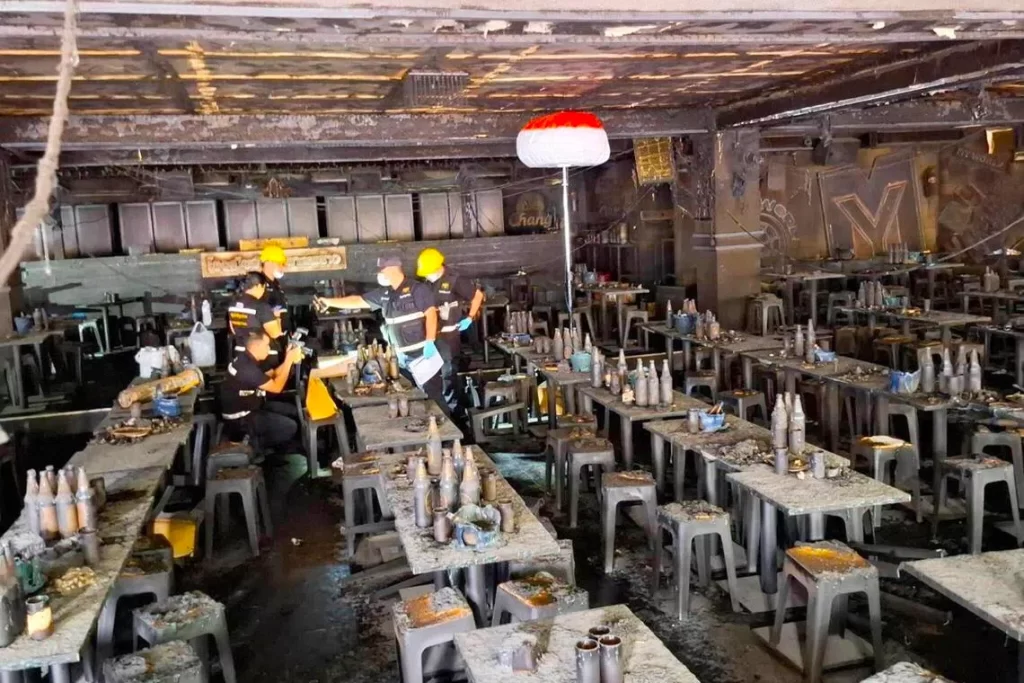
Photo Source: Bundit Pradabsoo
A tragic bar fire in Bangkok has placed fire safety compliance back in the public spotlight. According to CNA coverage, at least 27 people were killed after a fire broke out at the Rong Beer Na Lat Phrao bar in Bangkok. CNA also reported that Thai police were looking into whether a rear exit was locked at the time, whether sufficient emergency exits were in place, and an alleged structure or extension near the stage that was under forensic examination.
At the time of writing, the investigation remains ongoing. That point is important. Businesses should not treat early reports as final findings, nor assume that any one factor caused the tragedy. Official investigators still need to determine what happened and whether any laws or fire safety requirements were breached.
For building owners, facility managers, employers and F&B operators in Singapore, the responsible framing is simple: fire safety is not just about having equipment installed. It is about keeping every system, every escape route and every safety procedure compliant, maintained and ready to work when people need them most.
A fire protection system that exists only on paper does not protect occupants. A fire alarm with unresolved faults, an exit sign with a failed battery, an extinguisher blocked by storage boxes, a door that cannot be opened during occupancy, or a layout change that was never reviewed can all reduce safety margins during an emergency.
Compliance Is Not a Once-a-Year Exercise
Singapore has a detailed fire safety framework administered by the Singapore Civil Defence Force (SCDF). The SCDF Fire Code establishes minimum fire safety provisions for buildings and takes into account the design, management, operation and maintenance of buildings to protect occupants and property in the event of fire.
This is a key point for business owners: compliance is not only about design approval at handover. The building must remain compliant throughout its operational life. Fire protection systems deteriorate. Tenancy layouts change. Staff turnover affects emergency response. Stock, furniture, seasonal decorations, event equipment and temporary structures can gradually compromise routes that were originally designed to be safe.
SCDF Fire Code Clause 1.2.3 states that installed or provided fire protection systems shall be maintained in accordance with the applicable codes or standards. It also requires maintenance details to be documented in the Fire Safety Instruction Manual and handed over to the building owner for compliance. This makes maintenance a formal compliance obligation, not an optional facilities task.
For buildings that require a Fire Certificate, the SCDF Fire Certificate scheme is intended to ensure the proper maintenance and good working condition of fire safety systems. In other words, the objective is not simply to obtain a certificate. The objective is to ensure that the systems protecting occupants continue to work.
Fire Safety Consideration 1: Emergency Exits Must Be Usable at All Times
CNA reported that Thai police were examining whether the rear exit at the Bangkok venue was locked and whether sufficient emergency exits were in place. These remain investigation points. The general fire safety principle for all occupied premises is still clear: escape routes are life safety systems and must remain usable during occupancy.
In Singapore, the Fire Code’s means of escape provisions are designed to ensure that occupants can leave safely during a fire. The Fire Code states that areas designated as means of escape, such as exit staircases, fire lift lobbies, smoke-free lobbies, exit passageways and escape corridors, should not be turned into other uses. It also states that required exits should be readily accessible, with doors openable and unobstructed during building occupancy.
This means emergency exits cannot be treated as spare storage space. They cannot be narrowed by crates, chairs, event equipment or renovation works. Exit doors cannot be difficult to open, hidden behind displays or dependent on a staff member with a key. A route that looks compliant on a floor plan may become unsafe if daily operations are allowed to interfere with it.
A practical compliance habit is to conduct an exit walkdown before the premises opens each day, and again before major events or peak operating periods. Check every exit door, corridor, stairway and final discharge point as if you were an occupant trying to escape in smoke and darkness.
- Confirm that exit routes are free of storage, tables, cartons and equipment.
- Check that exit doors can be opened without special knowledge or a key during occupancy.
- Verify that exit signs and directional signs are visible from normal occupant positions.
- Inspect final exit discharge areas, not just internal corridors.
- Review crowd flow during events, live performances, festive periods and peak operating hours.
- Ensure temporary decorations, queue barriers, stage setups or movable partitions do not reduce required escape width.
Fire Safety Consideration 2: Fire Alarms Provide Critical Early Warning
In a fast-developing fire, early warning can support orderly evacuation and reduce panic. This section does not suggest what happened in the Bangkok incident. It explains a general compliance and maintenance principle: fire alarm systems must be inspected, tested and kept in working condition so occupants receive warning without avoidable delay.
A fire alarm system is only effective if every part of the system is maintained. Smoke detectors and heat detectors must remain responsive. Manual call points must be accessible. Sounders and visual alarms must operate throughout the premises. The fire alarm control panel must display and communicate faults accurately. Standby batteries must have sufficient capacity. Faults must be investigated and closed, not ignored.
For businesses with public occupancy, this is especially important because customers may not know the building layout. They rely on the alarm, signage, lighting and staff instructions. If the alarm is delayed, muted, isolated without proper controls or compromised by unresolved faults, the available evacuation time may be reduced.
A strong maintenance programme should include scheduled servicing by competent personnel, documented functional tests, device-by-device fault tracking, panel inspection, battery checks, alarm audibility reviews and prompt rectification of defects. For complex premises, zoning diagrams and emergency procedures should also be kept current so staff and responders can quickly understand where the alarm originated.
Fire Safety Consideration 3: Emergency Lighting and Exit Signs Must Work When Visibility Is Poor
Evacuation does not always happen in bright, clear conditions. Fires may be accompanied by smoke, power interruption, confusion and crowd movement. Emergency lighting and exit signs therefore deserve routine attention even though they are easy to overlook during normal operations.
Emergency lighting and exit signs are often overlooked because they are passive systems until an emergency occurs. Yet they are essential when normal lighting fails. A failed emergency light in a corridor, a weak battery in an exit sign or a directional sign hidden by decorations can create confusion when occupants are already under stress.
Maintenance should verify battery condition, charging status, illumination levels, operation duration, automatic changeover and visibility from occupant decision points. It is not enough to check that a green sign exists. The sign must be visible, illuminated, directional where necessary and supported by adequate emergency lighting along the route to safety.
Facilities teams should periodically test escape routes under realistic conditions. Walk from the most remote occupied areas to the final exit. Ask whether a first-time visitor, customer, contractor or new employee would know where to go if smoke reduced visibility. This simple exercise often reveals issues that a desk-based checklist misses.
Fire Safety Consideration 4: Electrical and ACMV Systems Need Preventive Attention
The CNA article should not be read as a final technical finding on ignition source or system failure. Even so, electrical and ACMV maintenance remains a standard fire safety consideration for commercial premises because faults can develop gradually and may be difficult to detect without planned inspection.
Electrical fire risks often develop gradually. Loose connections, overloaded circuits, damaged insulation, ageing components, temporary wiring, poorly managed stage equipment, overheating appliances and neglected air-conditioning units can all increase risk. In F&B, entertainment and event spaces, additional loads from sound systems, lighting rigs, screens, kitchen equipment and temporary decorations can further complicate the risk profile.
Preventive maintenance should include inspection of distribution boards, circuit loading, wiring condition, isolation points, temporary electrical installations, extension cord usage, cable management, equipment overheating and ACMV servicing records. Where appropriate, thermal imaging can help identify hotspots before they become failures.
Businesses should also have a change-control process. If a tenant adds a stage, extra lighting, large AV equipment, decorative installations, kitchen upgrades or temporary event fixtures, the impact on electrical loading, fire load, detection coverage and escape routes should be reviewed before the change is used.
Fire Safety Consideration 5: Renovation and Layout Changes Can Affect Fire Compliance
CNA reported that authorities were focusing on an area near the stage and that an alleged structure or extension was under forensic examination. Those details remain subject to investigation. For Singapore businesses, the neutral maintenance and compliance point is that layout changes, fit-out works and temporary event setups should be reviewed so they do not compromise escape routes or fire protection coverage.
Many fire safety problems appear after a building or tenancy has already been approved. A new partition, storage rack, display counter, stage platform, VIP area, queue barrier, acoustic treatment, false ceiling, decorative feature or event booth may seem operationally minor, but it can affect fire safety in several ways.
- It may reduce the width of an escape route.
- It may block the line of sight to an exit sign.
- It may obstruct access to an extinguisher, hose reel or manual call point.
- It may increase combustible loading or smoke production.
- It may interfere with smoke detector coverage or sprinkler discharge patterns.
- It may create dead ends, blind spots or crowd bottlenecks.
- It may require formal submission, approval or professional review before use.
This is why maintenance should not only be equipment-based. It must also include layout review and operational discipline. The question is not simply, “Was this approved when the premises opened?” The question is, “Is the premises still operating in a way that matches the approved fire safety design?”
Fire Safety Consideration 6: Fire Extinguishers and Hose Reels Must Be Accessible, Serviced and Understood
Portable fire extinguishers and hose reels are intended to support early-stage fire response when it is safe and appropriate to do so. They should never delay evacuation during a serious fire, but they can help trained staff control very small fires before they spread.
The key word is “ready”. An extinguisher that is overdue for servicing, blocked by furniture, missing its safety pin, incorrectly mounted or unsuitable for the hazard is not ready. A hose reel with poor water pressure, leaks, damaged nozzle or obstructed cabinet is not ready. A staff member who has never been trained may hesitate, use the wrong extinguisher, or attempt firefighting when evacuation should be the priority.
Maintenance should verify that extinguishers are in the correct locations, visible, accessible, within service dates and appropriate for the risks in the area. Hose reels should be checked for accessibility, condition, signage, nozzle operation, leakage and performance. Staff should be trained to understand when to use equipment, when to raise the alarm and when to evacuate immediately.
Fire Safety Consideration 7: Staff Training Completes the System
Fire protection systems are not only mechanical and electrical assets. People are part of the system. During an emergency, staff may need to guide customers, identify exits, raise the alarm, call emergency services, assist vulnerable occupants and prevent people from moving toward danger.
For public-facing businesses such as restaurants, bars, clubs, retail stores, clinics, schools and entertainment venues, staff training is especially important because customers are unfamiliar with the premises. They may follow staff cues. If staff do not know the evacuation procedure, panic spreads more quickly.
Training should be simple, repeated and practical. Employees should know the alarm signal, primary and secondary escape routes, assembly area, emergency contact process, basic extinguisher rules, evacuation assistance procedures and the importance of keeping exits clear. New employees should be briefed before they work alone, and all staff should receive refresher training periodically.
Fire Certificate Compliance: Maintenance Records Matter
For premises that fall under Singapore’s Fire Certificate requirements, compliance includes more than a certificate displayed in a file. SCDF states that the Fire Certificate scheme ensures the proper maintenance and good working condition of fire safety systems, and that these systems should be tested in accordance with the relevant codes of practice.
From 1 April 2026, SCDF’s three-year Fire Certificate regime reduces administrative renewal frequency for eligible buildings, but it does not remove the need for annual Professional Engineer inspections and certifications. SCDF’s published FAQ explains that annual PE inspections remain mandatory because mechanical and electrical systems can deteriorate over time, and regular certification helps ensure fire safety systems remain in good working condition for occupant safety.
This is a useful message for building owners and occupiers: a longer certificate period should not lead to a weaker maintenance culture. Fire safety systems need attention every year, every month and in some areas every day. SCDF also notes that random audits can occur annually, including in both renewal and non-renewal years, and that building owners or occupiers must ensure compliance at all times.
Maintenance records should therefore be complete, current and easy to retrieve. These records demonstrate due diligence, support audit readiness and help ensure defects are actually rectified rather than repeatedly noted.
- Fire alarm inspection and servicing reports
- Emergency lighting and exit sign test records
- Fire extinguisher servicing records
- Hose reel and pump test records
- Sprinkler, wet riser or dry riser maintenance records where applicable
- Electrical inspection and ACMV maintenance records
- Fault logs and rectification evidence
- Evacuation drill and staff training records
- Approved plans, renovation records and change-control documentation
- Daily or weekly exit route inspection checklists
Practical 30-Day Maintenance and Compliance Review Plan
Businesses do not need to wait for the final investigation report from Bangkok before improving their own premises. The most practical response is to review known risks now. The following 30-day plan can be adapted for commercial buildings, F&B outlets, offices, schools, industrial premises and retail spaces.
| Timeline | Focus Area | Action |
|---|---|---|
| Week 1 | Escape route audit | Walk every exit route during operating hours. Remove obstructions. Confirm doors are openable. Check exit sign visibility and final discharge points. |
| Week 1 | Fire alarm status review | Check the fire alarm panel, fault history, isolation status, recent service report and outstanding rectification items. |
| Week 2 | Emergency lighting and exit signs | Test emergency lighting operation and battery condition. Confirm signs are visible from occupant decision points, not just from the corridor. |
| Week 2 | Extinguishers and hose reels | Confirm accessibility, service dates, pressure, labels, signage, mounting and suitability for area hazards. |
| Week 3 | Electrical and ACMV review | Review distribution boards, temporary wiring, extension cords, overloaded circuits, stage or event power, air-conditioning servicing and thermal scan needs. |
| Week 3 | Layout and renovation review | Compare current layout with approved plans. Review partitions, stages, display counters, storage racks and any unapproved changes. |
| Week 4 | Staff training and drill | Brief staff on alarm response, evacuation routes, assembly areas, customer guidance and when not to fight a fire. |
| Week 4 | Records and compliance calendar | Compile service reports, certificates, PE inspection dates, defect closure evidence and next maintenance deadlines in one register. |
Maintenance Checklist for Building Owners and Facility Managers
| Area | What to Check | Recommended Rhythm |
|---|---|---|
| Emergency exits | Doors openable, routes clear, no storage, no unauthorised barriers, final exits accessible. | Daily / before events |
| Fire alarm system | Panel normal, detectors maintained, call points accessible, sounders functioning, faults closed. | Scheduled servicing plus routine checks |
| Emergency lighting | Battery capacity, automatic changeover, sufficient illumination along routes. | Scheduled testing |
| Exit signs | Visible, illuminated, directional signs provided where needed, not blocked by decor. | Routine walkdown |
| Extinguishers | Correct type, accessible, mounted, labelled, serviced, pressure acceptable. | Monthly visual / scheduled servicing |
| Hose reels | Cabinet accessible, nozzle condition, no leaks, adequate performance, clear signage. | Scheduled inspection and testing |
| Electrical systems | DB condition, loading, cable management, temporary wiring, ACMV condition, overheating signs. | Preventive maintenance cycle |
| Renovations and layout | No unauthorised partitions, stage extensions, storage changes or decor affecting egress or systems. | Before any change and periodically |
| Training | Staff know alarm response, evacuation routes, assembly area and emergency reporting procedure. | Onboarding and refreshers |
| Records | Service reports, defect rectification, PE inspections, drills and compliance documents filed. | Continuous |
How King Fire Helps Businesses Stay Compliant and Ready
King Fire Group helps businesses move from reactive fire safety to preventive fire protection maintenance. The goal is not simply to pass an inspection, but to keep critical life safety systems operational every day.
Our maintenance and compliance support can help building owners, facility managers, MCSTs and business operators review their current fire protection systems, identify defects, close maintenance gaps and plan servicing schedules before problems become urgent.
- Fire alarm system inspection, testing and maintenance
- Emergency lighting and exit sign testing
- Fire extinguisher servicing and replacement planning
- Fire hose reel inspection and maintenance
- Fire safety compliance walkdowns
- Maintenance documentation and defect follow-up support
- Fire safety training coordination and evacuation readiness reviews
When incidents happen overseas, the most responsible action is not to speculate. It is to ask whether our own buildings, workplaces and public spaces would be ready if a fire occurred today.
Conclusion: Keep Fire Safety Readiness Current
The Bangkok bar fire is a tragedy, and the official investigation should be allowed to determine the facts, causes and responsibilities. For businesses in Singapore, however, routine fire safety readiness can be reviewed without waiting for overseas investigation findings.
Emergency exits should be clear today. Fire alarms should be functional today. Emergency lighting should be ready today. Extinguishers, hose reels, electrical systems and maintenance records should be current today. Staff should know what to do today.
Fire safety compliance is not only a document. It is a living system made up of design, maintenance, operations, training and discipline. When every part works together, occupants have a better chance to evacuate safely and businesses have a stronger foundation for resilience.
If you are unsure whether your premises are fully compliant or whether your fire protection maintenance records are up to date, schedule a professional fire safety maintenance review with King Fire Group.
FAQ
How should Singapore businesses discuss the Bangkok bar fire while investigations are ongoing?
They should avoid speculating on final cause or liability. The safer approach is to use the incident as neutral context for reviewing emergency exits, fire alarms, emergency lighting, electrical and ACMV systems, staff training and maintenance records.
Why should businesses be careful when discussing ongoing fire investigations?
Early reports may identify issues under investigation, but final causes and liabilities can only be confirmed by official findings. A responsible article should use words such as “reported”, “investigating” and “preliminary”.
What does fire protection maintenance include?
It includes scheduled inspection, testing, servicing, repair and documentation for fire alarms, emergency lighting, exit signs, extinguishers, hose reels, sprinklers, risers, pumps and other systems where applicable.
Are emergency exits part of maintenance?
Yes. Exit routes require ongoing operational maintenance. They must remain accessible, unobstructed, visible and openable during occupancy. Storage or temporary event setups should never compromise escape routes.
Why are emergency lighting and exit signs important?
They guide occupants when normal lighting fails or smoke reduces visibility. Regular testing helps ensure batteries, lamps, charging circuits and visibility remain reliable during evacuation.
How can renovations affect fire safety compliance?
Partitions, stages, counters, racks, false ceilings, decorations and temporary structures can affect escape width, exit visibility, detection coverage, sprinkler patterns and combustible loading.
What should F&B and entertainment venues check before opening?
They should check exits, crowd flow, alarm status, emergency lighting, extinguisher access, electrical setups, decorations, stage equipment and staff evacuation roles before customers enter.
Does a Fire Certificate mean no further maintenance is required?
No. Fire safety systems can deteriorate over time. SCDF guidance on the Fire Certificate regime reinforces the need for regular inspections and good working condition of fire safety systems.
What records should building owners keep?
Maintain service reports, test results, defect rectification records, PE inspection documents, fire drill records, staff training logs, approved plans and exit route inspection checklists.
How can King Fire help?
King Fire can support fire alarm maintenance, emergency lighting checks, extinguisher servicing, hose reel inspection, compliance walkdowns, maintenance planning and fire safety education.
Sources:
- CNA – As it happened: Thai police probe possible negligence in deadly Bangkok bar fire: https://www.channelnewsasia.com/asia/bangkok-bar-fire-thailand-live-6249866
- SCDF Fire Code 2023 – Clause 1.2 Codes and Standards / Maintenance of fire protection systems: https://www.scdf.gov.sg/fire-safety-services-listing/fire-code-2023/table-of-content/chapter-1-general/clause-1.2-codes-and-standards
- SCDF – Fire Certificate: https://www.scdf.gov.sg/fire-safety-services-listing/permits-and-certifications/fire-certificate
- King Fire Group – Fire Protection Maintenance: https://www.kingfiresg.com/servicing-maintenance/
This article is published by King Fire Group as general fire protection commentary. It is intended for informational purposes only and should not be treated as professional advice, regulatory interpretation or a determination by the relevant authority. Project teams should consult qualified fire safety professionals and the relevant authorities for site-specific requirements.