
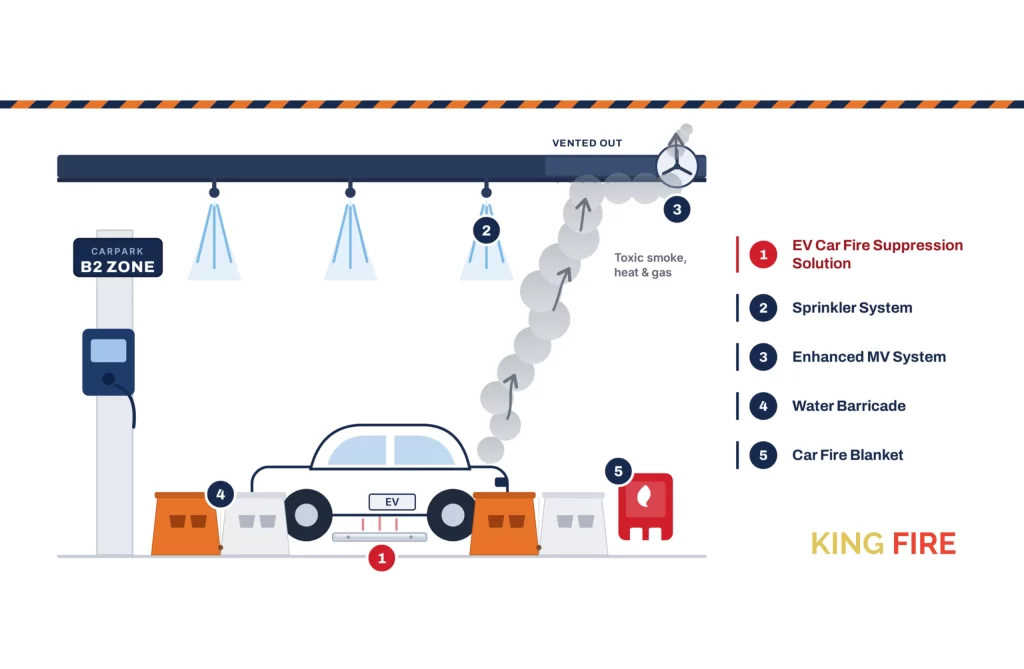
Electric vehicle adoption in Singapore is rising fast, and most of those vehicles are parked and charged indoors. That quietly changes the fire safety picture for building owners, MCSTs, facility managers and car park operators.
EV car fires are not common. Singapore’s own statistics show they are rare, and lower in rate than petrol and diesel vehicle fires. The point of this guide is not to overstate the risk. It is to explain why, on the rare occasion an EV fire does start in an indoor or underground car park, it is harder to manage than a conventional vehicle fire, and what a sound, layered response looks like.
This is an educational piece. The five-layer approach below is a way of thinking about EV car fire safety in enclosed car parks, combining the systems a building already has with the EV-specific measures that address the battery directly. King Fire, through its EVProtect range, focuses on those EV-specific measures.
Why EV car fires are different
A conventional vehicle fire usually involves fuel, engine components and cabin materials, and is fought from above and around the vehicle. An EV car fire is different because the main fire risk is the lithium-ion battery pack, which typically sits underneath the car. The battery can enter thermal runaway, releasing intense heat, dense and toxic smoke, and presenting a re-ignition risk even after visible flames are reduced. Because the source sits below the vehicle, it is hard to reach with overhead systems alone.
Why indoor and underground car parks are the harder case
In the open air, an EV fire has room to vent and is easier to approach. Enclosed car parks remove both advantages, and that is the real subject of this guide.
- The source is underneath the car. Overhead systems discharge from above, while the battery burns below, often shielded by the vehicle body.
- Smoke and heat have nowhere to go. In a sealed space, dense toxic smoke and heat build up quickly, cutting visibility and making evacuation and firefighting harder.
- Fire-engine access can be constrained. Low ceiling height, basement ramps, tight turning radius, narrow driveways, congestion and smoke can all slow responders reaching the affected bay.
- Re-ignition risk persists. A lithium-ion battery can retain heat and re-ignite after flames are knocked down, so the incident is not over when the visible fire is.
None of this means EVs are unsafe to park indoors. It means the enclosed environment narrows the margin for error, which is why a layered, site-level response matters.
What Singapore already requires
Singapore’s framework sets a strong baseline. For enclosed basement car parks, sprinklers are required, along with natural or mechanical ventilation to disperse smoke, heat and gases. Car parks are designed so a fire is contained within the car park for a minimum duration before SCDF arrives. For EV charging, since March 2022 an emergency main isolation shut-off switch must sit within 15 metres of every charging station, now set out in the SCDF Fire Code 2023 (Clause 10.4). A multi-agency EV Safety Taskforce co-chaired by SCDF and LTA has reviewed these requirements since 2023. These systems are the foundation. The EV-specific measures below sit on top of them, not in place of them.
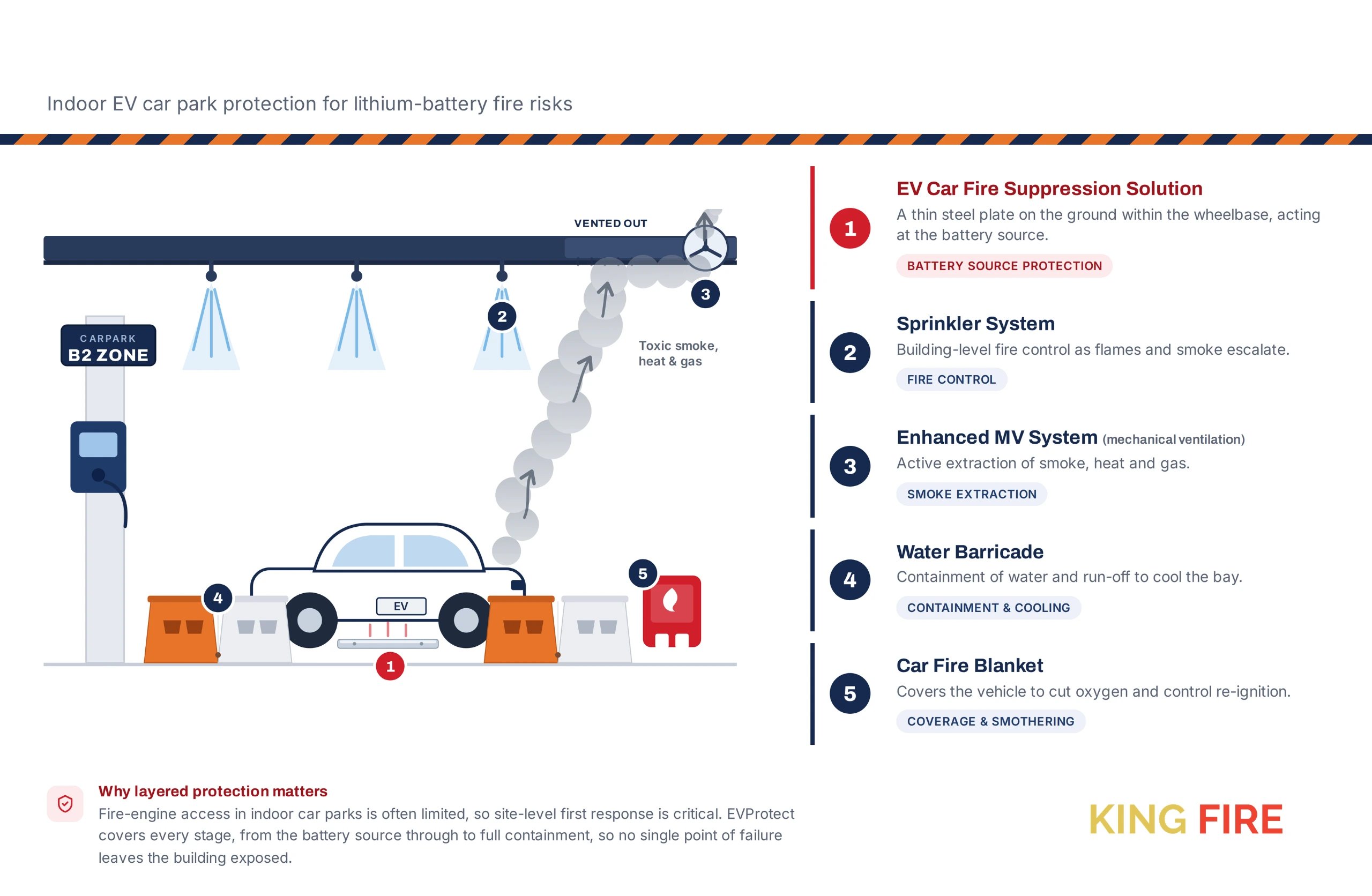
A Layered Approach to EV Car Fire Safety in Enclosed Car Parks
Because no single system addresses every stage of an EV car fire, a layered approach is the sound way to think about it. Five layers, working together, cover the journey from the battery source through to containment.
Layer 1 — EV Car Fire Suppression at the Battery Source
The first layer targets the hardest-to-reach part of the fire: the battery pack beneath the vehicle. A fixed EV fire suppression system like EV FirePro installed in the parking bay is designed to act at the underside of the car and respond when a battery enters thermal runaway, supporting early-stage cooling and suppression before the incident escalates. This is the EV-specific gap that overhead systems cannot reach directly.
Layer 2 — Sprinkler System (the building’s existing system)
Sprinklers are the building’s code-required, building-level layer. When flames, heat or smoke escalate beyond the vehicle, they control spread and protect adjacent vehicles, the structure and people evacuating. They discharge from above, which is exactly why a battery-source layer is needed below.
Layer 3 — Enhanced Mechanical Ventilation (the building’s existing system)
Mechanical ventilation, again part of the building’s required provisions, helps extract smoke, heat and gases from the enclosed space. In a car park where smoke build-up and limited access are the main hazards, managing the environment around the fire supports safer evacuation and a better working environment for responders.
Layer 4 — Water Barricade (a cooling-containment response measure)
Because a battery can retain heat and re-ignite, sustained cooling matters after visible flames drop. A water barricade placed around the affected vehicle contains cooling water within the bay, preventing run-off from draining away and supporting prolonged cooling of the battery pack. This is a response and containment measure rather than a product King Fire supplies, included here for a complete picture.
Layer 5 — Car Fire Blanket
A heavy-duty car fire blanket is deployed over the affected vehicle to isolate it, contain flames, smoke and heat, and limit spread to nearby vehicles while responders manage the incident. It is part of an emergency response plan and a practical first-response tool for trained personnel. It is not a guaranteed way to stop lithium-ion thermal runaway, and should be used as part of a broader plan. The Car Fire Blanket is the second EV-specific solution in King Fire’s EVProtect range.
The approach at a glance
Comparison Area |
EV FirePro | Car Fire Blanket |
|---|---|---|
| Main Purpose | Supports electric vehicle fire suppression and fire risk control. | Designed mainly for vehicle fire containment. |
| How It Works | Adds a dedicated EV fire suppression product to the premises as part of the fire safety plan. | Covers the affected vehicle to help isolate the fire area. |
| Best Used For | EV charging areas, car parks, workshops, fleet facilities and commercial premises that need stronger EV fire preparedness. | Car parks, workshops and vehicle storage areas where quick fire containment is needed. |
| Key Benefits | Helps facilities strengthen their EV fire protection strategy and emergency readiness. | Helps reduce the spread of flames, smoke and heat to surrounding vehicles and property. |
| Recommended Approach | Best used together with other fire protection systems and emergency response procedures. | Best used together with EV fire suppression solutions and emergency response procedures. |
Where EVProtect fits
Of the five layers, King Fire provides the two that are specific to electric vehicles. EVProtect is King Fire’s EV fire safety range for premises with EV parking, charging, storage or servicing: EV car fire suppression at the battery source, and the Car Fire Blanket for vehicle containment. They are designed to complement the building’s existing sprinklers, ventilation and emergency procedures, giving facility teams a stronger, EV-specific response in exactly the spot the building systems cannot reach. You can explore the EVProtect range, including EV FirePro and the Car Fire Blanket, on the EVProtect hub.
Why building owners should pay attention now
EV adoption is increasing and many properties are adding charging infrastructure. Readiness should not stop at the charger. Thinking through EV car fire safety early helps owners and facility teams strengthen site-level response, protect occupants and responders, reduce fire-spread risk, support business continuity and demonstrate responsible planning. The layered approach above is a simple framework for that conversation, and a starting point for assessing where the gaps are in a specific car park.
Conclusion
EV car fires are uncommon, but in an enclosed indoor or underground car park the battery location, smoke build-up, access limits and re-ignition risk make them disproportionately hard to manage. A layered approach answers that: the building’s sprinklers and ventilation do their part, and EV-specific measures, battery-source suppression and a car fire blanket, close the gap those systems cannot reach. As EV adoption grows, EV car fire safety deserves a place in every car park owner’s planning.
“In Singapore the issue isn’t how often EV fires happen, it’s how hard they are to deal with once one starts in an enclosed car park. The building’s sprinklers and ventilation do important work, but they were never designed to reach a battery burning under a car. That gap is what EV-specific measures are for.”
Kelvyn Ong, Managing Director and Fire Safety Manager, King Fire Group
Learn more about EVProtect. EVProtect is King Fire’s EV fire safety range, EV car fire suppression and the Car Fire Blanket, for premises with EV parking, charging, storage or servicing. Explore the range or speak to King Fire’s team for advice on your car park.
Explore EVProtect or Speak to our team today.
FAQs
Are EV car fires common in Singapore?
No. SCDF data shows EV fires are rare: 4 of 226 vehicle fires in 2025 involved EVs (1.77%), and EVs catch fire less often than petrol or diesel vehicles. The concern is not how often they happen, but how hard they are to manage in an enclosed car park.
Why are EV car fires harder to manage in indoor and underground car parks?
The battery sits beneath the vehicle, so the source is hard to reach from above. Smoke and heat build up in the enclosed space, fire-engine access can be limited, and the battery can re-ignite after visible flames are knocked down.
What is EVProtect?
EVProtect is King Fire’s EV fire safety range for premises with EV parking, charging, storage or servicing. It currently comprises EV car fire suppression (EV FirePro) and the Car Fire Blanket, the EV-specific measures that complement a building’s existing fire systems.
Which parts of this approach does King Fire provide?
King Fire provides the two EV-specific layers: battery-source suppression and the Car Fire Blanket. Sprinklers and mechanical ventilation are the building’s own code-required systems, and the water barricade is a response measure, not a King Fire product.
Is a sprinkler system enough for EV car fire safety?
Sprinklers are essential for building-level control, but they discharge from above while the battery sits below the vehicle. EV-specific measures target that gap at the source, alongside the sprinklers, not instead of them.
Can a car fire blanket extinguish an EV battery fire?
A car fire blanket helps contain visible flames and limit spread, but it should not be treated as a guaranteed way to stop lithium-ion thermal runaway. A battery can keep producing heat and gases, so it is used as part of a broader emergency response plan.
Does this approach replace existing fire protection?
No. It complements the systems a building already needs, sprinklers, ventilation, alarms, extinguishers and the mandated EV charging isolation switch, by adding EV-specific measures at the battery and the vehicle.
Who should pay attention to EV car fire safety?
Building owners, MCSTs and managing agents, facility managers, and operators of malls, hotels, condominiums, industrial and logistics sites, car parks and charging locations, anywhere EVs are parked, charged, stored or serviced indoors.
Why are EV car fires hard to manage in underground car parks?
The battery source sits beneath the vehicle, smoke and heat accumulate in the enclosed space, fire-engine access can be limited, and the battery can re-ignite after visible flames are controlled.
What is the best approach to EV car fire safety in indoor car parks?
A layered, site-level approach: the building’s sprinklers and mechanical ventilation, plus EV-specific measures, battery-source suppression and a car fire blanket, that target the parts those systems cannot reach.
Does a car fire blanket stop an EV battery fire?
It helps contain flames and limit spread, but it is not a guaranteed way to stop lithium-ion thermal runaway. It is used as part of a broader emergency response plan.
What does EVProtect cover?
EVProtect is King Fire’s EV fire safety range: EV car fire suppression at the battery source and a heavy-duty car fire blanket, designed to complement a building’s existing fire systems.