
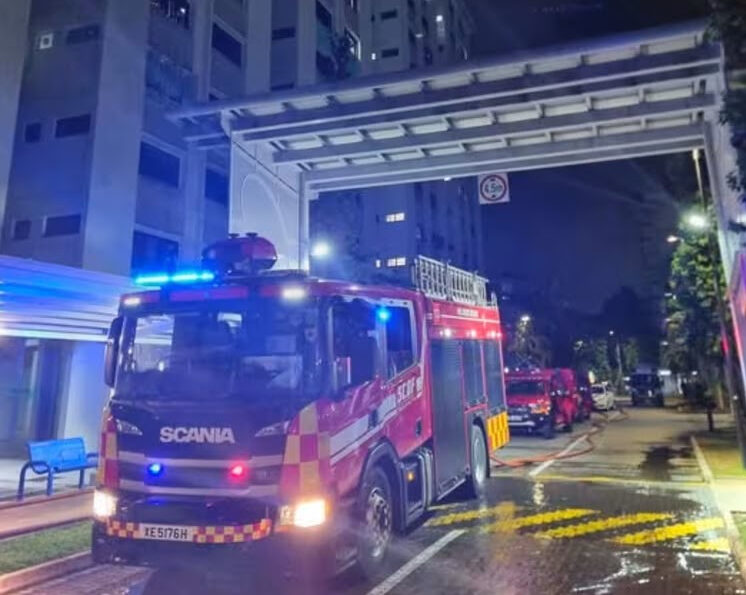
Photo Source: A fire broke out in a unit at Block 309, Clementi Ave 4 on Jul 31, 2026 from Facebook/SCDF
On 31 July 2026, the Singapore Civil Defence Force (SCDF) was alerted at about 11.10pm to a fire in an eighth-floor unit at Block 309 Clementi Avenue 4. Firefighters arrived to find the living room alight, forced entry and extinguished the fire with two water jets. [CNA incident report]
During the operation, firefighters found that the block’s dry riser – formally a dry rising main under the SCDF Fire Code – was not in proper working condition. The resulting drop in water pressure prevented water from being supplied effectively to the affected floor. The crew used a contingency they train for during routine drills: hoses connected directly to the fire engine at ground level and run up the staircase to the eighth floor. [CNA follow-up]
The flat’s occupant was found in the kitchen and taken to Ng Teng Fong General Hospital, where the person later died. Two firefighters sustained burn injuries and were taken to Singapore General Hospital; one was discharged the following day. About 40 residents were evacuated as a precaution. The cause of the fire remains under investigation. [CNA incident report]
The Holland-Bukit Panjang Town Council said the dry riser had last been serviced and pressure tested on 14 March 2026 – four months and 17 days before the fire – and was found to be in working order. The town council said the system is serviced every six months and pressure tested annually. SCDF said the town council was required to rectify the dry riser and that the incident was under investigation. [CNA follow-up]
The system therefore had a current service and test record, but it still did not deliver effective water pressure to the eighth floor during the emergency. That gap between a recorded test result and real-world performance is the focus of this article.
The certification-readiness gap
Fire protection systems typically carry a documented history: approved plans, commissioning records, servicing schedules and test results. That record describes the system’s verified state – what it was observed to do, under defined conditions, on a defined date.
What matters during a fire is the system’s operational state – whether it delivers water, at pressure, to the floor that needs it under the mechanical and hydraulic conditions of an actual firefighting operation.
These are not the same property. The present operational state is inferred from earlier inspections and tests. The distance between the verified record and real-world performance is the certification-readiness gap.
The gap is not an indictment of periodic testing. Testing is a central practical tool for detecting faults that may otherwise remain hidden. The gap is a structural feature of any regime that verifies a system at intervals and relies on continuity between those checks. Incidents such as Clementi provide important evidence about where that assumption can break down.
What is known about the Clementi failure
The Holland-Bukit Panjang Town Council’s preliminary assessment attributed the pressure loss to a coupling securing a segment of the dry riser becoming dislodged during the firefighting operation. [CNA follow-up]
If that preliminary assessment is confirmed, the coupling became dislodged during the operation. However, the public record does not establish why it became dislodged or whether a pre-existing weakness contributed. It would therefore be unsafe to conclude that no earlier inspection could have identified a relevant condition.
Recorded state: found to be in working order on 14 March 2026. Operational state: ineffective pressure on 31 July 2026.
That is the shape of the gap in this case: a system with a current test record did not perform as required during the emergency. Whether the investigation ultimately confirms the coupling mechanism or identifies another cause, the interval between verification and operation is the interval every maintenance regime must manage. This same readiness principle is important across fire safety systems, including EV car fire suppression solutions, where systems must remain ready to perform when required.
A maintenance record evidences a past inspection or test. Readiness is the system’s present ability to perform.
Why more frequent testing is not, by itself, the answer
A pressure test establishes that the system held pressure, at the pressure applied, when the test was conducted. By itself, it does not establish:
- whether a joint will hold under the exact mechanical and hydraulic conditions of a later firefighting operation
- whether a component will degrade, loosen, move or become damaged before the next test
- whether the system is left in the correct condition after subsequent servicing, repair or other intervention
- whether a concealed section develops a fault after the test or below the detection threshold of the test method
More frequent testing can reduce the maximum time between checks, but it cannot eliminate faults that arise after a test or during an emergency. The publicly available information also does not establish whether a pre-existing weakness contributed to the coupling becoming dislodged at Clementi.
A more productive response addresses the readiness gap directly:
- Test the complete water path, not only isolated components. A dry riser is a delivery system from the breeching inlet at fire-engine access level to the landing valve on the affected floor.
- Treat post-work verification as a distinct step. The condition in which a system is left after servicing or repair should be recorded, not assumed.
- Record measurements and observed conditions, not only a pass or fail result. Where applicable, pressure readings and decay observations provide better diagnostic context across visits.
- Treat contingency as a designed layer. SCDF’s staircase-hose contingency worked at Clementi because it is drilled; building-side response arrangements should likewise be reviewed and documented.
Where the Fire Code sets the baseline
A dry riser – which the Fire Code calls a dry rising main – is defined in the SCDF Fire Code 2023 as a vertical pipe installed in a building for firefighting purposes, fitted with inlet connections at fire-engine access level and landing valves on various floors. It is normally dry but can be charged with water, usually by pumping from a fire engine. [SCDF Fire Code, Clause 6.2]
Under Clause 6.2.1a, dry rising mains are required in Purpose Group II to VIII buildings with a habitable height of more than 10 metres but not more than 60 metres. Wet rising mains are required where habitable height exceeds 60 metres. The Code explains that the 60-metre limit avoids excessive pumping pressure and states that total pressure loss in a dry rising main should not exceed 6 bar at the design flow rate. [SCDF Fire Code, Clause 6.2]
Clause 6.2.2a requires the number, distribution, size and installation of rising mains to comply with SS 575. Clause 6.2.2b requires rising mains and associated landing valves to be kept free of physical and visual obstruction. [SCDF Fire Code, Clause 6.2]
On maintenance, SCDF’s Fire Safety Guidelines for Residential Estate state that fire safety and firefighting provisions are to be regularly serviced to ensure operational readiness at all times. The guidance also says access to dry and wet riser compartments, landing valves and breeching inlets must remain unobstructed, and landing-valve lugs should be checked regularly and replaced immediately if missing. [SCDF residential guidance]
The regulatory baseline is clear. Public reporting shows that the block had a dry riser and a current service and test record; it does not establish full compliance with every applicable requirement or the ultimate cause of the malfunction.
What building owners and town councils should be asking
These questions are not a suggestion that any of these areas was deficient at Block 309. They are general considerations that follow from how the certification-readiness gap works.
- Does the maintenance scope verify the complete water path or only a list of components?
- Are actual readings and pressure-decay observations recorded, or only a pass result?
- Are couplings, brackets, joints and concealed pipe runs explicitly within the inspection scope?
- Is there a defined verification step covering the condition in which the system is left after any work?
- Are recurring or borderline findings tracked across visits rather than assessed in isolation?
- Is it documented which parts of the system could not be accessed on each visit?
- Do relevant building personnel know the first actions to take if the primary system does not perform?
- Can the full maintenance and rectification history be retrieved promptly if requested by SCDF?
What this article does not claim
SCDF’s investigation into the Clementi fire is ongoing, and the town council’s coupling assessment is explicitly preliminary. Nothing here should be read as establishing that maintenance was neglected at Block 309, that the March test was improperly conducted, that a contractor failed to identify a detectable fault, that the servicing frequency was inadequate, or that any party is responsible for the malfunction. No authority has stated that the dry riser’s condition caused or contributed to the death or the firefighters’ injuries.
The central point does not depend on those questions being answered one way or another. Public reporting establishes that the dry riser had a current servicing and test record and did not provide effective water pressure to the eighth floor during the fire.
Fire Protection Servicing and Maintenance in Singapore
King Fire Group provides preventive maintenance, inspection, testing and servicing support for building fire protection systems, covering fire alarm and detection systems, water-based suppression systems, dry and wet risers, hose reels, fire extinguishers and other fire safety provisions, subject to applicable system requirements and contracted scope.
Learn more about King Fire Group’s fire protection servicing and maintenance services.
Frequently Asked Questions
What happened to the dry riser during the Clementi fire?
SCDF found that it was not in proper working condition. The resulting drop in water pressure prevented water from being supplied effectively to the eighth floor, so firefighters ran hoses directly from the fire engine at ground level up the staircase – a contingency they train for during routine drills. [CNA follow-up]
Had the Clementi dry riser been maintained?
Yes, according to the town council. It said the dry riser was last serviced and pressure tested on 14 March 2026 and was found to be in working order. The system is serviced every six months and pressure tested annually. [CNA follow-up]
What caused the loss of water pressure?
The town council’s preliminary assessment attributed it to a coupling securing a segment of the dry riser becoming dislodged during the firefighting operation. Why the coupling became dislodged has not been established publicly. SCDF is investigating. [CNA follow-up]
Does this mean maintenance is ineffective?
No. Servicing and testing remain central methods of finding faults. The narrower point is that a passed test is evidence about the time and conditions of the test, not a guarantee for every condition that may arise later.
What is the certification-readiness gap?
It is the distance between a system’s verified state – what testing showed on a given date under defined conditions – and its operational state, meaning whether it performs during an actual fire. The present state is inferred from earlier checks rather than continuously measured.
What is a dry riser?
A dry riser, formally a dry rising main under the SCDF Fire Code, is a vertical firefighting pipe with inlet connections at fire-engine access level and landing valves on various floors. It is normally empty and is charged with water by a fire-engine pump during a fire. [SCDF Fire Code]
Are dry risers mandatory in Singapore?
Under Clause 6.2.1a of the SCDF Fire Code 2023, dry rising mains are required in applicable Purpose Group II to VIII buildings with a habitable height of more than 10 metres but not more than 60 metres. Buildings exceeding 60 metres in habitable height require wet rising mains. [SCDF Fire Code]
How often must a dry riser be tested?
The applicable frequency should be confirmed against the current SS 575 requirements, approved system documentation, regulatory requirements and the building’s maintenance scope. In the Clementi case, the town council said the system was serviced every six months and pressure tested annually; that reported schedule should not be treated as universal. [CNA follow-up]
Does passing a pressure test guarantee the system will work?
No. It establishes that the system met the applied test conditions when the test was conducted. It cannot guarantee that no component will later loosen, deteriorate, move, become damaged or respond differently under actual firefighting conditions.
What happens if a dry riser fails during a fire?
Firefighters may establish an alternative supply by connecting hoses directly to the fire engine and running them up the staircase. SCDF said its firefighters regularly train for this contingency and used it at Clementi. [CNA follow-up]
References
- Channel NewsAsia – Firefighters hauled hose up 8 floors after dry rising main failed in fatal Clementi fire, 3 August 2026
- Channel NewsAsia – One person dead, two firefighters injured in Clementi flat fire, 1 August 2026
- The Straits Times – Fatal Clementi blaze: Dry rising main not in proper working condition during firefighting operation, 2 August 2026
- Singapore Civil Defence Force – Fire Code 2023, Clause 6.2: Rising Main and Hose Reel Systems
- Singapore Civil Defence Force – Fire Safety Guidelines for Residential Estate
- Holland-Bukit Panjang Town Council – Official website
- King Fire Group – Fire Protection Servicing and Maintenance
This article is published by King Fire Group as general fire protection commentary. It is intended for informational purposes only and should not be treated as professional advice, regulatory interpretation or a determination by the relevant authority. Project teams should consult qualified fire safety professionals and the relevant authorities for site-specific requirements.