
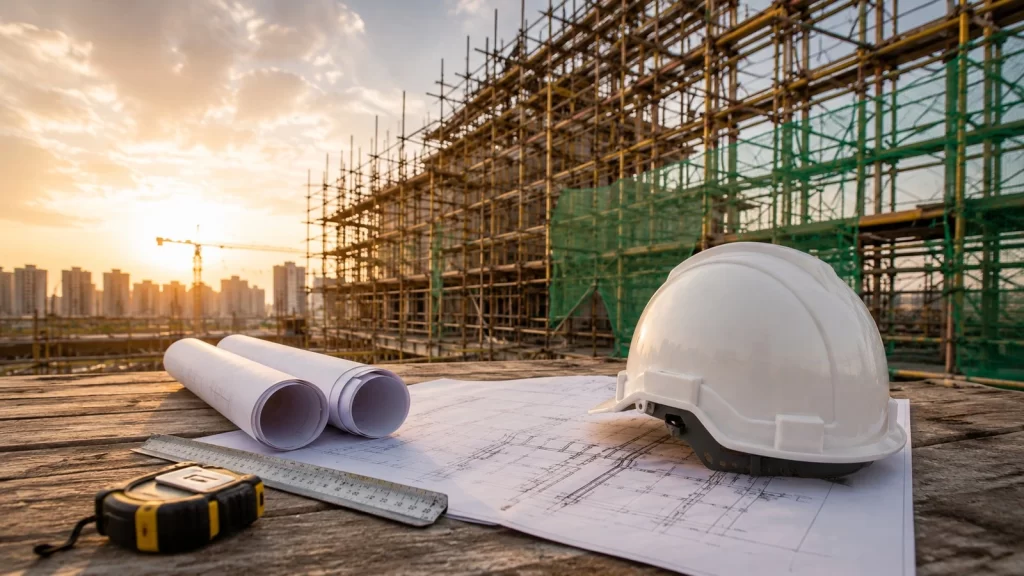
SINGAPORE – From 1 January 2027, Singapore will shorten the permitted use period for timber scaffolds from nine months to three months. The Ministry of Manpower (MOM) introduced the change to reduce scaffold fire risks on construction sites, particularly where combustible timber materials remain on-site for prolonged periods and where hot works such as welding, cutting or grinding may take place.
MOM and the Singapore Civil Defence Force (SCDF) are also reviewing possible fire performance requirements for scaffold nettings installed outside buildings. This signals a wider shift in construction site fire safety: reducing the presence of combustible materials, managing temporary works more closely, and reviewing fire risks earlier in the project planning process.
This article explains what the new rule means, why it matters, and what contractors, building owners, developers, managing agents and project teams should review before 2027.
The Short Answer
From 1 January 2027, timber scaffolds in Singapore must be dismantled within three months of erection, down from the current nine months.
Timber scaffolds set up before 1 January 2027 may continue to be used for up to nine months under the existing framework. However, any new timber scaffold erected from 1 January 2027, including on sites already in progress, will be subject to the new three-month limit. Extensions may be considered on a case-by-case basis where technical constraints or other extenuating circumstances apply.
The rule was announced by MOM on 2 July 2026 as part of updated scaffold fire safety requirements. MOM stated that scaffold fires can spread rapidly, complicate evacuation and firefighting efforts, and result in significant damage, disruption and potential loss of life.
A second measure is still under review. MOM and SCDF are studying fire performance requirements for netting that envelops scaffolds set up outside buildings. More details are expected to be shared ahead of implementation.
What the New Rule Does
The new requirement does not add more equipment to a worksite. It does not introduce a new detector, suppression system or alarm requirement.
Instead, it reduces the duration that combustible timber materials remain on-site.
That distinction matters. Fire protection is often discussed in terms of detection, suppression, containment and evacuation. These are essential controls, but they usually engage after ignition has occurred. The scaffold rule addresses a different part of the risk equation: reducing the amount and duration of combustible material available to burn in the first place.
In practical terms, a timber scaffold standing for nine months presents a longer exposure window than one standing for three months. This is especially relevant on active construction sites where hot works, temporary power, storage, waste materials and changing site conditions can all influence fire risk.
Why Timber Scaffolds Are a Fire Safety Concern
MOM has identified two key concerns.
First, timber is combustible. If ignited, timber scaffolding can contribute to the spread of fire, particularly when combined with other combustible materials, scaffold netting, temporary coverings or poor housekeeping around the site.
Second, timber can deteriorate over time. Weather exposure, wear and tear, and mechanical damage may affect its condition. By shortening the permissible duration, MOM aims to encourage more regular renewal and replacement of timber scaffold materials, reducing the likelihood of undetected defects.
The new rule therefore addresses both fire risk and structural safety. It also encourages the adoption of more durable, non-combustible scaffold systems such as steel, aluminium and metal modular systems.
The rule does not ban timber scaffolds. However, it may change the cost-benefit calculation. If timber scaffolds need to be dismantled and re-erected more frequently, contractors may need to reassess whether timber remains the most practical choice for certain projects.
What This Says About the Direction of Fire Safety Regulation
The updated scaffold rule points to a broader principle: fire safety is not only about responding to a fire after it starts. It is also about reducing the conditions that allow a fire to grow quickly.
This is sometimes described as fuel-load control. The idea is simple: reduce the amount, duration or combustibility of materials that could contribute to a fire.
For construction sites, this thinking is especially important because site conditions change frequently. Temporary structures, external scaffold systems, nettings, coverings, hoarding, storage areas and hot works zones can create fire risks that are not always fully reflected in the building’s permanent fire strategy.
For project teams, the message is clear: temporary works should be treated as part of the fire safety planning process, not as a separate construction detail.
Why Scaffold Nettings Are Also Under Review
MOM and SCDF are reviewing the introduction of fire performance requirements for scaffold netting used outside buildings.
This is important because scaffold netting often envelops the external scaffold system. It can cover large vertical areas, and if the material does not meet appropriate fire performance standards, it can contribute to flame spread along the building exterior.
As of July 2026, the final requirements have not yet been published. MOM has stated that obligations may be placed on scaffold contractors, netting manufacturers, netting suppliers and/or other relevant parties in the industry.
When the requirements are released, project teams should pay close attention to three areas:
1) Who is responsible for compliance?
The duty may not sit with one party alone. Scaffold contractors, suppliers, manufacturers and main contractors may all have roles to play in ensuring that materials supplied, installed and maintained on-site meet the required standards.
2) What evidence is required?
A supplier certificate may not be enough on its own. Project teams should understand what documentation, test standards, batch information or verification process will be expected.
3) How is compliance maintained during service?
Netting is exposed to sunlight, rain, abrasion and site activity. Fire performance should not be treated as a one-time check at installation only. Project teams should consider whether inspection and replacement practices are needed during the scaffold’s service period.
Lessons from the Wang Fuk Court Fire
The announcement came after Singapore reviewed early findings from the Wang Fuk Court fire in Hong Kong, which occurred on 26 November 2025. The fire spread across seven high-rise residential blocks and resulted in 168 deaths, including one firefighter.
CNA reported that the towers were clad in bamboo scaffolding with nylon netting that did not meet Hong Kong’s safety codes. In Singapore, bamboo scaffolding is not allowed, and timber scaffolds are subject to height restrictions.
That distinction is important, but it should not lead to complacency. The broader lesson is not only about the type of scaffold material used. It is also about material compliance, verification, fire performance, site controls and enforcement.
A safer regulatory framework on paper still depends on correct material selection, proper documentation, responsible installation, regular inspection and site-level discipline.
What Contractors and Project Teams Should Review Before 2027
The new rule takes effect on 1 January 2027, but the fire risk it addresses exists on live worksites today. Contractors and project teams should use the transition period to review upcoming and ongoing projects.
Key areas to review include:
1) Scaffold material selection
Review whether timber, steel, aluminium or metal modular scaffold systems are most appropriate for each project. Where timber is planned, map the scaffold duration against the project programme.
2) Scaffold erection duration
Any timber scaffold that is expected to stand beyond three months after 1 January 2027 should be flagged early. Project teams should not assume that an extension will be granted.
3) Hot works interface
Review the relationship between scaffolds and hot works such as welding, cutting and grinding. Check permit-to-work discipline, separation distances, screens, fire watch arrangements and post-work monitoring.
4) Fire load around the site
Assess whether combustible materials, waste, temporary storage, protective sheeting, packaging or debris are accumulating near scaffold areas.
5) Scaffold netting and covering materials
Ask suppliers and scaffold contractors what netting is being supplied, what fire performance evidence is available, and how material compliance can be verified.
6) Emergency readiness
Ensure that suitable fire extinguishers, hose reels, access routes, alarm procedures and emergency response arrangements are available and maintained during the worksite period.
7) Temporary works inside occupied buildings
Refurbishment, alteration and addition works, and fit-out projects can create construction-like risks within occupied premises. These temporary works should be considered within the project’s fire safety planning.
Fire Safety Checklist for Construction Sites
Before 1 January 2027, project teams should consider the following checklist:
- Map all planned timber scaffolds against the project timeline.
- Identify any scaffold duration that may exceed three months.
- Reassess whether non-combustible scaffold systems should be used.
- Review hot works permits, fire watch and post-work monitoring.
- Check housekeeping around scaffold areas.
- Confirm the type and fire performance evidence of scaffold nettings.
- Review extinguisher and hose reel availability near work areas.
- Maintain clear emergency access and evacuation routes.
- Include temporary works in the site fire safety strategy.
- Verify documentation, site conditions and implementation, not just paperwork.
What This Means for Building Owners, Developers and Managing Agents
The rule is directly relevant to contractors, but building owners, developers and managing agents should also pay attention.
Many fire risks during construction, A&A works and renovation projects arise from temporary site conditions. These can include scaffold systems, hot works, temporary storage, protective coverings, temporary power and works taking place near occupied areas.
Owners and project stakeholders should ask practical questions early:
- What scaffold material will be used?
- How long will the scaffold remain in place?
- Are hot works expected near scaffold areas?
- What netting or covering material will be installed?
- What fire safety equipment will be available during the works?
- Who verifies compliance on-site?
- What is the emergency response plan if a fire occurs during works?
These questions can help reduce fire risk before work begins, rather than after a problem is discovered on-site.
Where King Fire Comes In
King Fire supports contractors, building owners, managing agents and project teams with fire protection systems, fire safety equipment, inspection support, maintenance and advisory for worksite fire protection readiness.
For projects involving scaffolds, A&A works, renovation works or temporary work zones, early review can help identify fire risks linked to combustible materials, hot works, access routes, extinguishers, hose reels, alarm systems and emergency preparedness.
The key takeaway is simple: build safer, plan earlier and reduce fire risk before it becomes an emergency.
FAQs
When does the new timber scaffold rule take effect in Singapore?
The new rule takes effect on 1 January 2027.
How long can a timber scaffold stand under the new rule?
From 1 January 2027, timber scaffolds may be used for up to three months from the date of erection, down from the current nine-month limit.
What happens to timber scaffolds erected before 1 January 2027?
Timber scaffolds set up before 1 January 2027 may continue to be used for up to nine months under the existing framework. Any new timber scaffold set up from 1 January 2027 will be subject to the three-month limit.
Are extensions possible?
Yes. MOM has stated that extensions beyond the permissible duration may be granted on a case-by-case basis, based on extenuating circumstances such as technical constraints.
Why did Singapore change the rule?
MOM stated that timber scaffolds are combustible and can accelerate fire spread when ignited. The shorter duration is intended to reduce fire risks from the prolonged presence of combustible timber materials, particularly in environments involving hot works. It also addresses concerns about timber deterioration over time.
Is bamboo scaffolding allowed in Singapore?
CNA reported that bamboo scaffolding is not allowed in Singapore. Timber scaffolds are allowed but are subject to regulatory controls, including height restrictions.
Are scaffold netting rules changing too?
MOM and SCDF are reviewing fire performance requirements for netting that envelops scaffolds set up outside buildings. As of July 2026, the final requirements have not yet been published.
Does the three-month rule apply to steel or aluminium scaffolds?
The updated duration requirement applies to timber scaffolds. MOM has stated that the change encourages the adoption of more durable, non-combustible scaffold systems such as steel, aluminium and metal modular scaffold systems.
Do contractors need to change immediately?
The new timber scaffold duration requirement takes effect from 1 January 2027. However, contractors should review project programmes, scaffold material choices and fire safety planning before the effective date to avoid disruption later.
What should project teams do now?
Project teams should review scaffold material selection, expected scaffold duration, hot works controls, fire load, netting materials, fire protection equipment and emergency readiness. They should also verify documentation and on-site implementation, not just rely on assumptions.
Need to review fire protection readiness for your construction site, A&A works or temporary work zone? King Fire supports contractors, building owners and project teams with fire safety equipment, inspection support, fire protection maintenance and site-specific fire risk advisory.
Sources
- Ministry of Manpower, Update on Scaffold Fire Safety Requirements, 2 July 2026.
https://www.mom.gov.sg/newsroom/press-releases/2026/0702-factsheet-on-updated-scaffold-fire-safety-requirements
- The Straits Times, Singapore tightens timber scaffold rules to reduce fire risk after 2025 Hong Kong blaze, 2 July 2026.
https://www.straitstimes.com/singapore/timber-scaffolds-must-be-dismantled-within-3-months-to-reduce-fire-risk-tan-see-leng
- CNA, Singapore to shorten timber scaffold use from 9 months to 3 to improve fire safety, 2 July 2026.za
https://www.channelnewsasia.com/singapore/singapore-shorten-timber-scaffold-use-9-months-3-improve-fire-safety-6225201
This article is published by King Fire Group as general fire protection commentary. It is intended for informational purposes only. Project teams should consult qualified fire safety professionals and the relevant authorities for site-specific requirements.