
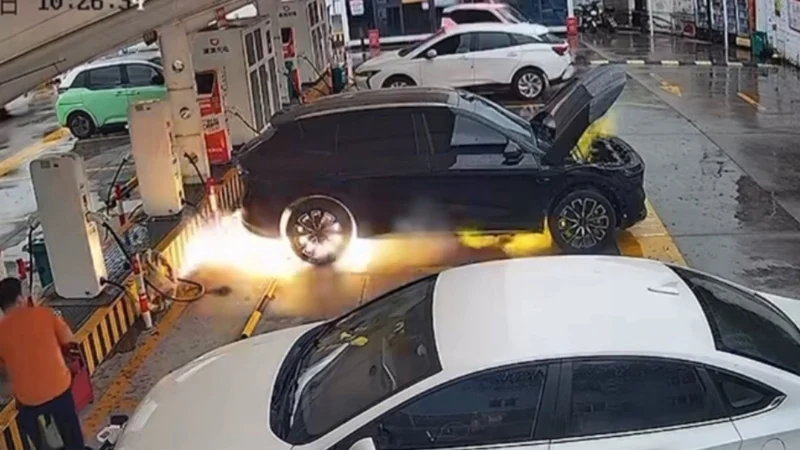
Photo Source: The Zeekr 7X caught fire in China. Credit to: Shuma IT Jun.
A Zeekr 7X electric SUV caught fire at a charging facility in Ningbo, China, on August 9, 2026. No injuries were reported. Zeekr says its preliminary investigation found that the vehicle had previously been involved in a serious collision and had not subsequently been inspected or repaired by an authorised service centre. However, the automaker has not concluded that the battery caused the fire, and the official cause remains under investigation. [CarNewsChina] [Gasgoo]
The incident is significant not because it proves that electric vehicles are inherently more prone to fire, but because it highlights a specific issue relevant to EV ownership:
What happens to a high-voltage battery and electrical system after a vehicle has been seriously damaged?
That question becomes increasingly important as more electric vehicles remain on the road for longer, enter the second-hand market and undergo accident repairs.
What happened to the Zeekr 7X in Ningbo?
The incident occurred on August 9, 2026, at a charging facility in Ningbo, Zhejiang province. [CarNewsChina]
Video footage reported by CarNewsChina showed a Zeekr 7X developing smoke, flames and repeated popping sounds before firefighters arrived and extinguished the fire. No injuries were reported. [CarNewsChina]
Gasgoo identified the location as a public charging station in Haishu District, Ningbo, and similarly reported that firefighters responded and that no one was injured. [Gasgoo]
There is, however, an important discrepancy in the available reporting.
Gasgoo described the vehicle as having caught fire while charging, while CarNewsChina reported that video footage showed the Zeekr 7X was not physically connected to a charger at the time the fire began. [Gasgoo] [CarNewsChina]
Until authorities establish the exact circumstances, the most accurate description is therefore:
The Zeekr 7X caught fire at a charging station.
It should not yet be stated definitively that charging caused, initiated or was even occurring at the time of the fire.
What has Zeekr said about the fire?
According to both Gasgoo and CarNewsChina, Zeekr issued a statement through its official ZEEKR Service account shortly after the incident. Zeekr confirmed an overheating incident involving a vehicle at a Ningbo charging facility and said it had dispatched personnel to the location and established a special team to handle the incident. [Gasgoo] [CarNewsChina]
According to the company’s preliminary investigation:
- The Zeekr 7X had previously been involved in a serious collision.
- The vehicle had not subsequently been inspected or repaired at an official authorised Zeekr service centre.
- Zeekr is cooperating with fire and other relevant authorities on inspections and analysis.
- The final cause will depend on the official investigation.
These points are part of Zeekr’s preliminary account and should not be read as a final determination of cause. [Gasgoo]
This is an important distinction. Zeekr has not stated that the previous collision caused the fire. Nor has it concluded publicly that the vehicle’s high-voltage battery entered thermal runaway. The previous accident is currently part of the factual background under investigation – not a confirmed cause.
Why did Zeekr highlight the vehicle’s collision history?
Zeekr used its statement to remind EV owners that the traction battery, high-voltage electrical system and vehicle body structure should be professionally inspected after a collision. The company also advised buyers of second-hand electric vehicles to verify accident and repair histories and ensure that critical high-voltage components have been appropriately inspected. [Gasgoo]
This advice is technically significant because an electric vehicle carries high-voltage components that may not show obvious external signs of damage after an accident. A vehicle can be cosmetically repaired while the condition of the battery pack, electrical connections or other high-voltage components requires separate assessment.
The Ningbo investigation has not established that this occurred in the Zeekr 7X involved. But the incident illustrates why post-collision inspection is an important part of EV safety.
Can collision damage lead to an EV battery fire?
Yes, severe physical damage to a high-voltage lithium-ion battery can create a fire risk – but that does not mean collision damage caused this particular Zeekr fire.
The US National Transportation Safety Board has investigated EV crashes in which high-voltage lithium-ion batteries were physically damaged and subsequently caught fire. The NTSB identifies electrical shock, thermal runaway and battery reignition as hazards associated with damaged high-voltage batteries. [NTSB]
Thermal runaway occurs when damaged battery cells experience an uncontrolled increase in temperature and pressure. Heat can then affect other cells within the battery pack, potentially resulting in sustained fire or reignition. [NTSB]
In three high-speed crashes examined by the NTSB, damaged lithium-ion batteries reignited after firefighters had initially extinguished the vehicle fires. [NTSB]
These documented cases explain why a seriously damaged EV requires more than a conventional bodywork assessment. The battery and high-voltage system may also need specialist evaluation.
Did the Zeekr 7X battery cause the Ningbo fire?
That has not been established.
The videos reportedly show flames, smoke, sparks and popping sounds around the vehicle, but visual footage alone cannot determine the technical origin of a vehicle fire. [CarNewsChina]
Zeekr has said the cause remains subject to investigation by the relevant authorities. [Gasgoo]
Until that investigation is complete, the incident should therefore be described as a fire involving a Zeekr 7X electric vehicle. It should not yet be described conclusively as:
- A battery fire
- Battery thermal runaway
- Spontaneous combustion
- A charging-related fire
- A defect caused by the previous collision
Any of those conclusions would go beyond the currently available evidence.
Why this distinction matters
EV fire discussions often collapse three different statements into one:
An electric vehicle caught fire. | The EV battery became involved in the fire. | The EV battery caused the fire.
They are not the same. Determining the origin and cause of a vehicle fire may require examination of physical fire patterns, vehicle diagnostic data, battery-management-system records, high-voltage components, collision history and repair work.
The Ningbo Zeekr incident is a particularly good example of why those distinctions matter. There is a confirmed vehicle fire. There is a confirmed previous serious collision, according to Zeekr’s preliminary investigation. But there is not yet a confirmed causal connection between the two. [Gasgoo]
Is this incident related to Zeekr’s 2026 battery recall?
There is currently no evidence connecting the Ningbo Zeekr 7X incident with Zeekr’s separate 2026 battery recall.
In February 2026, China’s State Administration for Market Regulation announced a recall covering 38,277 Zeekr 001 WE vehicles manufactured between July 8, 2021 and March 18, 2024. [SAMR]
The regulator said manufacturing-consistency issues affecting components within some high-voltage batteries could lead to abnormal increases in internal resistance and, in extreme cases, battery thermal runaway. [SAMR]
The recall applies to specified Zeekr 001 WE vehicles – not the Zeekr 7X involved in the Ningbo incident. [SAMR]
The two matters should therefore remain completely separate unless an authority subsequently establishes otherwise.
What does this incident tell us about used EVs?
One of the more important long-term questions raised by the incident concerns the growing second-hand EV market. Zeekr specifically advised prospective used-EV buyers to examine accident and maintenance records and ensure that the traction battery and high-voltage systems have been appropriately assessed. [Gasgoo]
For consumers, this suggests that buying a used EV may require additional due diligence beyond checking mileage, body condition and general servicing history. A vehicle that has experienced a substantial collision may warrant specialist assessment of:
- The battery enclosure
- High-voltage cables and connections
- Battery isolation systems
- Electrical insulation
- Cooling systems
- Battery-management-system fault records
- Structural areas surrounding the battery pack
The appropriate assessment depends on the vehicle manufacturer and the nature of the collision.
What does the Zeekr fire mean for Singapore?
The Ningbo incident does not demonstrate that Zeekr vehicles operating in Singapore face the same risk. Nor should one international incident be used to characterise the overall safety of EVs.
Singapore’s own data indicates that EV fires remain relatively uncommon. According to the Land Transport Authority and Singapore Civil Defence Force, EVs represented about 6% of Singapore’s vehicle population in 2025 but accounted for approximately 1.8% of vehicle fires. That equated to around seven fires per 100,000 EVs, compared with approximately 22 per 100,000 internal-combustion-engine vehicles. [LTA & SCDF]
However, Singapore’s authorities also emphasise that where an EV’s high-voltage battery becomes involved, thermal runaway can require a different emergency response. [LTA & SCDF]
That distinction is increasingly relevant as Singapore’s EV population grows.
Why damaged EVs deserve particular attention
For building owners, managing agents and carpark operators, the Ningbo case raises another practical consideration. A building generally has no knowledge of whether an EV entering its carpark:
- Has previously been involved in an accident
- Has suffered damage to its battery enclosure
- Has undergone non-authorised repairs
- Has unresolved high-voltage faults
Most EVs will never present such an issue. But unlike a vehicle manufacturer or repair workshop, the carpark operator has little ability to assess the condition of each individual vehicle. That means site-level EV fire preparedness cannot rely solely on preventing defective vehicles from entering a property. It also requires preparation for the possibility that a vehicle fire could occur despite normal operating controls.
EV fire preparedness in indoor and underground carparks
Singapore already has requirements covering EV charging infrastructure and general carpark fire protection. But a fire involving a high-voltage lithium-ion battery can present specific challenges including thermal runaway, sustained cooling requirements and possible reignition. [LTA & SCDF]
For indoor and underground carparks, this raises questions around:
- Early detection
- Battery-level cooling
- Existing sprinkler protection
- Smoke and heat management
- Preventing fire spread to adjacent vehicles
- Emergency access
- Vehicle containment
- Post-fire monitoring
King Fire’s EVProtect five-layer framework is one approach for considering these risks at site level. The framework is not an SCDF or LTA regulatory requirement and does not replace the Singapore Fire Code.
Learn more about the EVProtect framework: EV Car Fire Safety in Indoor and Underground Car Parks – EVProtect 5-Layer Approach
What should motorists do if an EV catches fire in Singapore?
The Land Transport Authority and Singapore Civil Defence Force advise the public not to attempt to extinguish a suspected EV battery fire without appropriate equipment and training. Dry-powder extinguishers are less effective against fires involving EV batteries. Members of the public should move at least 15 metres away and call 995. [LTA & SCDF]
Life safety should always take priority over attempting to save the vehicle.
The larger lesson from Ningbo
The investigation into the Zeekr 7X fire is not complete. We therefore do not yet know whether the fire originated from:
- The traction battery
- Another high-voltage component
- A low-voltage electrical component
- Previous accident damage
- Repair work
- Another source entirely
The available evidence supports none of these as a final conclusion.
What is established is narrower but still important. A Zeekr 7X caught fire at a charging facility in Ningbo. The vehicle had previously suffered a serious collision, according to Zeekr’s preliminary investigation. It had not subsequently been inspected or repaired by an official authorised Zeekr service centre. And Zeekr has explicitly highlighted the importance of evaluating the battery, high-voltage electrical system and vehicle structure after a significant collision. [Gasgoo]
EV safety does not end when an accident-damaged vehicle has been made driveable again. The integrity of the high-voltage system and traction battery also matters – particularly after a serious collision.
For drivers, repairers, used-car buyers and building operators, that is a more meaningful lesson than prematurely labelling every EV incident a “battery fire”.
Frequently Asked Questions
Did a Zeekr 7X catch fire in Ningbo?
Yes. CarNewsChina and Gasgoo reported that a Zeekr 7X caught fire at a charging facility in Ningbo, Zhejiang, on August 9, 2026. No injuries were reported. [CarNewsChina] [Gasgoo]
Was the Zeekr charging when the fire started?
This is unclear. Gasgoo described the incident as occurring while charging, while CarNewsChina reported that video footage showed the vehicle was not connected to a charger when the fire began. Until the investigation clarifies this point, it is safest to describe the incident as occurring at a charging station. [Gasgoo]
What did Zeekr say caused the fire?
Zeekr has not announced a cause. Its preliminary investigation found that the vehicle had previously experienced a serious collision and had not subsequently been inspected or repaired by an official authorised service centre. The company says the final cause remains under investigation. [Gasgoo]
Did the Zeekr battery enter thermal runaway?
That has not been confirmed publicly. The cause of the fire remains under investigation.
Can an EV battery be damaged in a collision?
Yes. NTSB investigations have documented high-voltage lithium-ion batteries damaged in severe crashes subsequently entering thermal runaway and catching fire. [NTSB]
Is the Ningbo fire related to Zeekr’s 001 recall?
There is no evidence of a connection. The official 2026 recall covers specified Zeekr 001 WE vehicles. The Ningbo incident involved a Zeekr 7X. [SAMR]
What should I check when buying a used EV?
Zeekr advises buyers to verify the vehicle’s accident and repair history and ensure that the traction battery and high-voltage system have been properly inspected, particularly where a vehicle has previously been involved in a collision. [Gasgoo]
Are EV fires more common than petrol-car fires in Singapore?
Available Singapore figures indicate a lower reported incidence rate for EVs. In 2025, there were approximately seven fires per 100,000 EVs compared with about 22 per 100,000 internal-combustion-engine vehicles. [LTA & SCDF]
References
- CarNewsChina – “Zeekr released statement on the 7X SUV ignition at the charging station”, August 10, 2026
- Gasgoo – “ZEEKR Responds to 7X Fire at Ningbo Charging Station: Vehicle Involved in Serious Collision and Not Officially Repaired”, August 10, 2026
- National Transportation Safety Board – Safety Risks to Emergency Responders from Lithium-Ion Battery Fires in Electric Vehicles
- National Transportation Safety Board – Risks to Emergency Responders from High-Voltage Lithium-Ion Battery Fires
- China State Administration for Market Regulation – Recall of Certain Zeekr 001 WE Vehicles, February 9, 2026
- Land Transport Authority & Singapore Civil Defence Force – Robust Standards and Public Awareness Key to Safety, March 9, 2026
- Land Transport Authority & Singapore Civil Defence Force – EV Identification and Emergency Response, April 10, 2026
- King Fire Group – EV Car Fire Safety in Indoor and Underground Car Parks: EVProtect 5-Layer Approach
This article is published by King Fire Group as general fire protection commentary. It is intended for informational purposes only and should not be treated as professional advice, regulatory interpretation or a determination by the relevant authority. Project teams should consult qualified fire safety professionals and the relevant authorities for site-specific requirements.